15 days to MLB Opening Night
30 days to Masters Tournament
35 days to NBA Playoffs
39 days to Stanley Cup Playoffs

Are Sports Teams Becoming Infrastructure Assets?
The Quiet Transformation of Sports Ownership
For decades, the economics of owning a professional sports team were relatively simple. An ownership group bought the franchise, operated the club, negotiated media deals, and hoped appreciation outpaced operating losses.
Today, that model looks increasingly outdated.
Professional teams are evolving into something far more complex and far more valuable. The shift began subtly when Major League Baseball allowed institutional capital into team ownership structures. What started as a carefully controlled opening has produced a ripple effect across the sports investment landscape.
Private equity firms are not merely buying slices of teams. They are investing across entire franchise ecosystems.
- Minority stakes.
- Regional media economics.
- Stadium districts.
- Adjacent real estate developments.
- Content and data rights.
Taken together, these elements are transforming teams from simple sports properties into diversified operating companies with multiple revenue engines.
And baseball is proving to be the laboratory where much of this financial experimentation is taking shape.
But the trend is not stopping there.
Similar capital structures are now emerging across the National Basketball Association, National Football League, and even international football clubs where ownership models have long been more fluid.
The real question is no longer whether institutional capital will shape sports ownership.
The question is what exactly investors believe they are buying.
Because increasingly, they are not buying a team.
They are buying infrastructure.
Why Baseball Became the Test Case for Private Equity
Major League Baseball has historically been one of the most conservative leagues when it comes to ownership rules. Yet it was also among the first to formally allow private equity firms to purchase minority stakes in franchises.
At the time, the logic seemed straightforward. Franchise valuations were climbing rapidly. Liquidity was limited. Allowing institutional investors provided owners a way to unlock capital without giving up control.
But the consequences have extended well beyond balance sheet flexibility.
Private equity firms approach assets differently than traditional owners. Their focus is not simply on team operations or championships. It is on the broader ecosystem of value creation surrounding the franchise.
That means asking questions such as:
-
What is the long term value of the stadium footprint
-
Can surrounding land support mixed use development
-
What media rights are embedded within the franchise structure
-
What digital distribution opportunities exist
-
How resilient are revenue streams during downturns
These questions reframe the team itself as just one piece of a larger operating platform.
And baseball teams often possess the perfect ingredients for this approach.
Many clubs control or influence stadium districts in large metropolitan markets (think Atlanta Braves). Long term media agreements provide predictable revenue streams. The season schedule creates consistent content inventory that feeds broadcast and streaming partners.
From a capital markets perspective, the result is something investors find attractive.
- Recurring cash flow.
- Real assets.
- Long duration value.
That combination begins to resemble infrastructure.
The Rise of Franchise Ecosystems
Historically, the value of a sports team was tied closely to three pillars.
- Ticket sales.
- Media rights.
- Sponsorships.
Those pillars still matter. But modern franchise valuations increasingly rely on a fourth dimension.
The ecosystem surrounding the team.
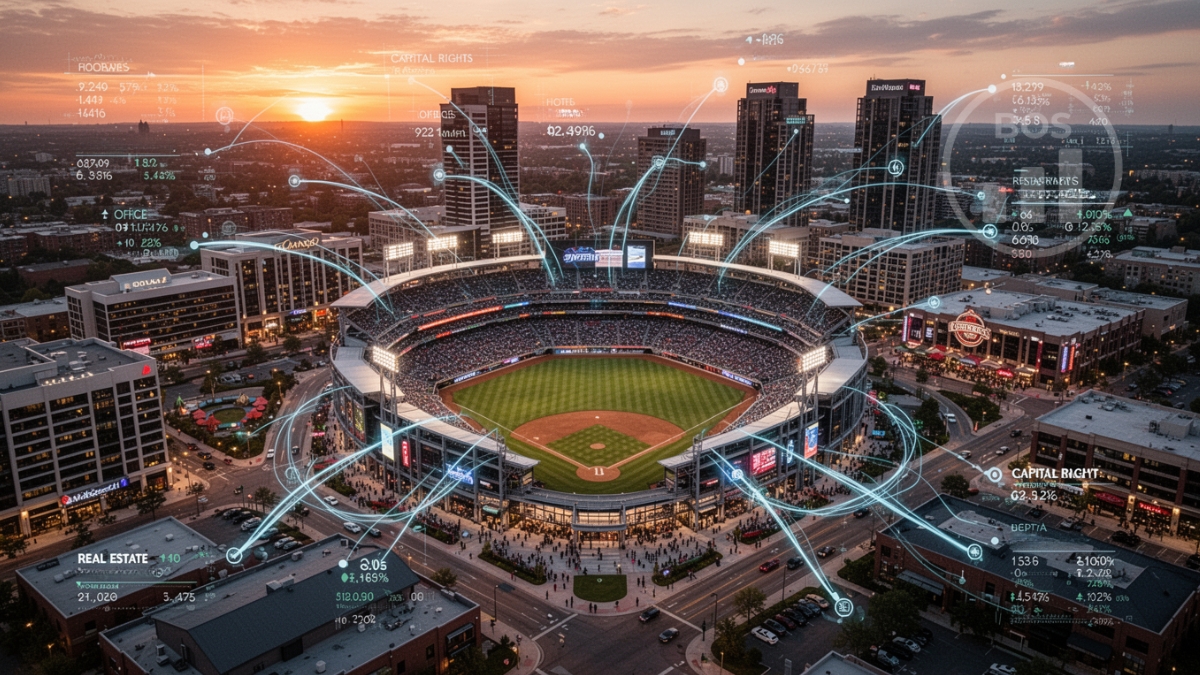
Stadium districts have become major economic engines. New arenas and ballparks often anchor entire neighborhoods filled with hotels, retail, restaurants, and residential developments.
Ownership groups frequently maintain equity stakes in these developments, creating additional revenue streams independent of the team's performance.
This is where private equity interest intensifies.
From an investor's perspective, the stadium complex begins to resemble a mixed use real estate platform with a globally recognizable brand at its center.
Media also plays a crucial role.
The upheaval in regional sports networks has created opportunities for new distribution models, direct to consumer streaming, and digital partnerships. As leagues rethink how live games reach audiences, teams increasingly participate in those media economics.
Meanwhile, technology and data infrastructure are becoming valuable assets themselves.
- Fan data platforms.
- Streaming analytics.
- Digital content production.
These components further expand the business footprint of modern franchises.
Viewed together, the team becomes only the most visible part of a much larger economic machine.
How Minority Stakes Unlock New Capital Structures
Minority ownership positions have become the preferred mechanism for private equity firms entering sports.
These stakes allow investors to deploy capital while respecting league rules designed to preserve competitive integrity and long term ownership stability.
But minority positions also introduce new financial strategies.
Institutional investors often structure deals around specific asset segments within the broader franchise ecosystem. In some cases, media rights or real estate developments are carved out into separate entities.
That structure allows different types of investors to participate in different layers of the business.
For example:
- The team entity remains controlled by the primary ownership group.
- Media assets can be structured into separate ventures.
- Stadium developments may involve outside real estate capital.
Each component carries its own risk profile and investment horizon.
This layered approach resembles the financial engineering often seen in infrastructure projects such as airports, toll roads, or utilities.
Which brings us back to the core shift occurring in sports ownership.
Franchise equity is evolving into a long duration capital asset.
Why Other Leagues Are Watching Closely
Baseball may have opened the door, but the rest of the sports world is watching closely.
The National Basketball Association has also allowed institutional investors into minority positions. With global popularity and expanding media reach, NBA teams present similar ecosystem opportunities.
Meanwhile, the National Football League historically maintained stricter ownership rules, but mounting franchise valuations and capital requirements have sparked renewed discussions around institutional participation.
Even in global football, where private ownership models have long been common, investment groups are beginning to view clubs through the same ecosystem lens.
- Stadium redevelopment.
- Global content rights.
- International fan engagement.
These elements create diversified revenue streams that mirror what private equity firms seek in other sectors.
The result is a broader shift across the sports industry.
Teams are no longer evaluated solely as entertainment brands.
They are becoming integrated business platforms with multiple profit centers.
Signals Executives Should Watch in Sports Investment
For executives across sports business, several signals suggest this infrastructure style model will continue expanding.
1. Stadium District Expansion
Teams increasingly control development around their venues. Expect more mixed use projects that extend the economic footprint of the franchise.
2. Media Rights Fragmentation
As regional networks evolve, teams will experiment with new distribution models that allow them to retain greater control over content and data.
3. Institutional Capital Participation
Private equity funds are building dedicated sports investment strategies. That capital requires scalable opportunities across leagues and markets.
4. Asset Segmentation
Ownership groups may increasingly separate team operations, media businesses, and real estate holdings into distinct financial vehicles.
5. Long Horizon Investment
Unlike traditional private equity timelines, sports assets often hold value for decades. Investors are adapting their strategies to match those horizons.
Together, these signals reinforce the idea that sports franchises are entering a new financial era.
When Franchise Equity Becomes Infrastructure
Infrastructure assets share several defining traits.
- They generate recurring demand.
- They operate over long time horizons.
- They serve as foundational components of broader economic systems.
Professional sports teams increasingly fit this description.
Games produce consistent media content. Stadium districts anchor urban development. Fan bases provide durable engagement across generations.
When investors evaluate these elements collectively, they see something more than a team competing on the field.
They see a platform capable of generating value across media, real estate, technology, and entertainment.
That perspective explains why institutional capital continues to move toward sports.
And it explains why franchise valuations continue climbing even amid media industry disruption.
The underlying asset is becoming larger than the game itself.
What This Means for the Future of Sports Ownership
If teams truly are becoming diversified operating companies, ownership will inevitably evolve alongside them.
Future ownership groups may resemble consortiums that combine expertise across several industries.
- Media operators.
- Real estate developers.
- Technology platforms.
- Institutional investors.
Each partner contributes capabilities that extend the economic potential of the franchise.
For leagues, this creates both opportunity and complexity. Institutional capital can accelerate innovation and growth, but it also requires thoughtful governance to maintain competitive balance and long term stability.
For fans, much of this financial transformation happens quietly behind the scenes.
But its effects shape everything from stadium experiences to streaming access to the economics that determine which teams thrive.
The shift underway is not merely about ownership rules.
It is about redefining what a sports franchise actually is.
Join the Conversation With Back Office Sports
The financial architecture behind sports is evolving faster than ever.
Private equity is only one piece of a much larger story unfolding across leagues, media companies, and global investment markets. Teams are no longer just sports properties. They are diversified economic platforms operating at the intersection of entertainment, real estate, and media.
Understanding that shift is essential for anyone working inside the sports industry.
At Back Office Sports, we focus on the strategy behind the spotlight. The deals, ownership structures, and financial signals shaping the future of global sports.
The next chapter of sports ownership may look less like a roster and more like an investment portfolio.